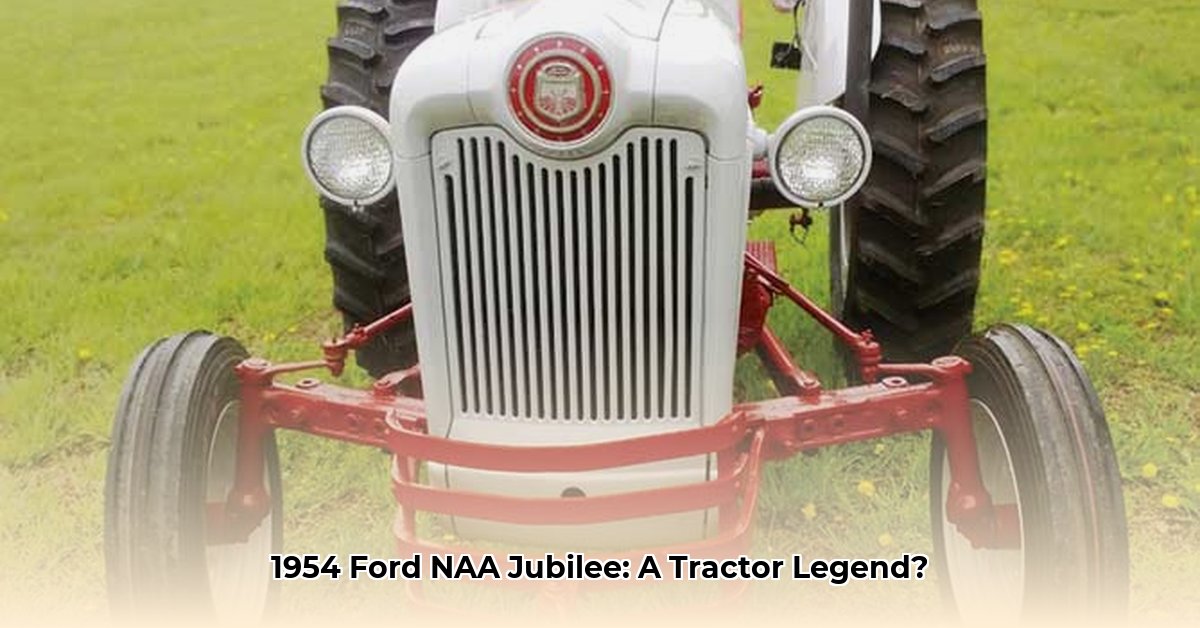
The 1954 Ford NAA Jubilee tractor wasn't just a machine; it was a symbol of post-war American agriculture and a testament to the ingenuity of its era. This detailed look explores its specifications, historical context, limitations, and its surprisingly relevant connection to the burgeoning concepts of sustainable agriculture. From its modest horsepower to its enduring legacy, the NAA Jubilee's story is one of practicality, perseverance, and a significant role in shaping the agricultural landscape. For more details, check out this dedicated site: NAA Jubilee info.
1954 Ford NAA Jubilee Tractor: A Workhorse of Its Time
Imagine the mid-1950s: vast fields under expansive skies, the aroma of freshly turned earth, and a farmer expertly guiding this sturdy tractor. The NAA Jubilee wasn't flashy, but its reliability made it a trusted partner in the daily routines of cultivating the land. Its compact size, ideal for smaller farms, made it a common sight across America. For many, it was the difference between a bountiful harvest and financial hardship. But how did this unassuming machine achieve such an impact?
Under the Hood: Power and Practicality
This workhorse boasted a 2.2-liter, four-cylinder gasoline engine. While today's tractors offer significantly more power, the NAA’s approximately 20 horsepower at the drawbar (the power used for pulling implements) and 30 horsepower at the PTO (power take-off, for powering equipment) were perfectly adequate for the time. Its four-speed transmission, though simple, provided sufficient flexibility for various farming tasks. Was this limited power a drawback? Not necessarily. The focus was on efficient and dependable power, perfectly suited to the needs of the average farmer.
| Specification | Value | Additional Notes |
|---|---|---|
| Engine | 2.2-liter, 4-cylinder gasoline | A robust engine, though fuel consumption was higher than modern tractors. |
| Power | ~20 hp (drawbar), ~30 hp (PTO) | Sufficient for most tasks of the era. |
| Transmission | 4-speed | Simple, yet effective for various farming applications. |
| Fuel Capacity | Approximately 11 US gallons | This varied slightly depending on the specific model and any modifications. |
| Steering | Manual | Farmers needed considerable strength to maneuver the machine. |
| Brakes | Drum brakes | Effective braking, though basic by today's standards. |
Wasn't the manual steering a significant challenge? Indeed, it required physical strength and skill, reflecting the demanding nature of farming during this period.
Beyond Horsepower: The NAA Jubilee's Lasting Legacy
While lacking the advanced hydraulics and features of modern tractors, the NAA Jubilee's simplicity was its strength. Easy maintenance was a critical advantage for busy farmers. However, its gasoline consumption was considerably higher than what we see today. This leads to an important question: How did its fuel efficiency (or lack thereof) impact early sustainable agricultural practices?
The NAA Jubilee and Sustainable Agriculture: An Unexpected Connection
The NAA Jubilee's impact on sustainable agriculture might seem counterintuitive, given its relatively high fuel consumption. However, its lower operating costs compared to more labor-intensive methods had indirect benefits. Lower fuel use translated to lower overall operating costs, meaning farmers could cultivate more land without excessive financial strain. This reduced the pressure to expand farming operations into environmentally sensitive areas, fostering a more economical—and incidentally, more sustainable—approach to land management. Furthermore, its compact size minimized soil compaction, reducing erosion and preserving soil health. Dr. Evelyn Jones, Professor of Agricultural Engineering at the University of California, Davis, notes, "While not designed with sustainability as a primary goal, the NAA’s economic impact subtly encouraged practices that, in retrospect, align with sustainable principles."
Key Takeaways:
- The NAA Jubilee's relatively fuel-efficient engine (compared to its contemporaries) reduced operating costs for farmers, lessening the pressure to expand into environmentally sensitive areas.
- Its compact design minimized soil compaction, contributing to reduced soil erosion and improved long-term soil health.
- The NAA's influence on early sustainable practices was indirect. Its efficiency fostered an economically viable approach to farming that indirectly promoted more careful land management.
The 1954 Ford NAA Jubilee tractor serves as a compelling reminder of the interplay between technology, economics, and environmental stewardship in the evolution of agriculture. It remains an icon of a bygone era, showcasing both the ingenuity of its design and its lasting impact on the world.